Santa Casa brings its community-focused approach to the Health Forum 2026
The need to bring healthcare and social services closer to the people was at the heart of the Health 2026 Forum, which took place this Thursday, 8 October, in the Social Services Auditorium at Câmara Municipal de Lisboa.
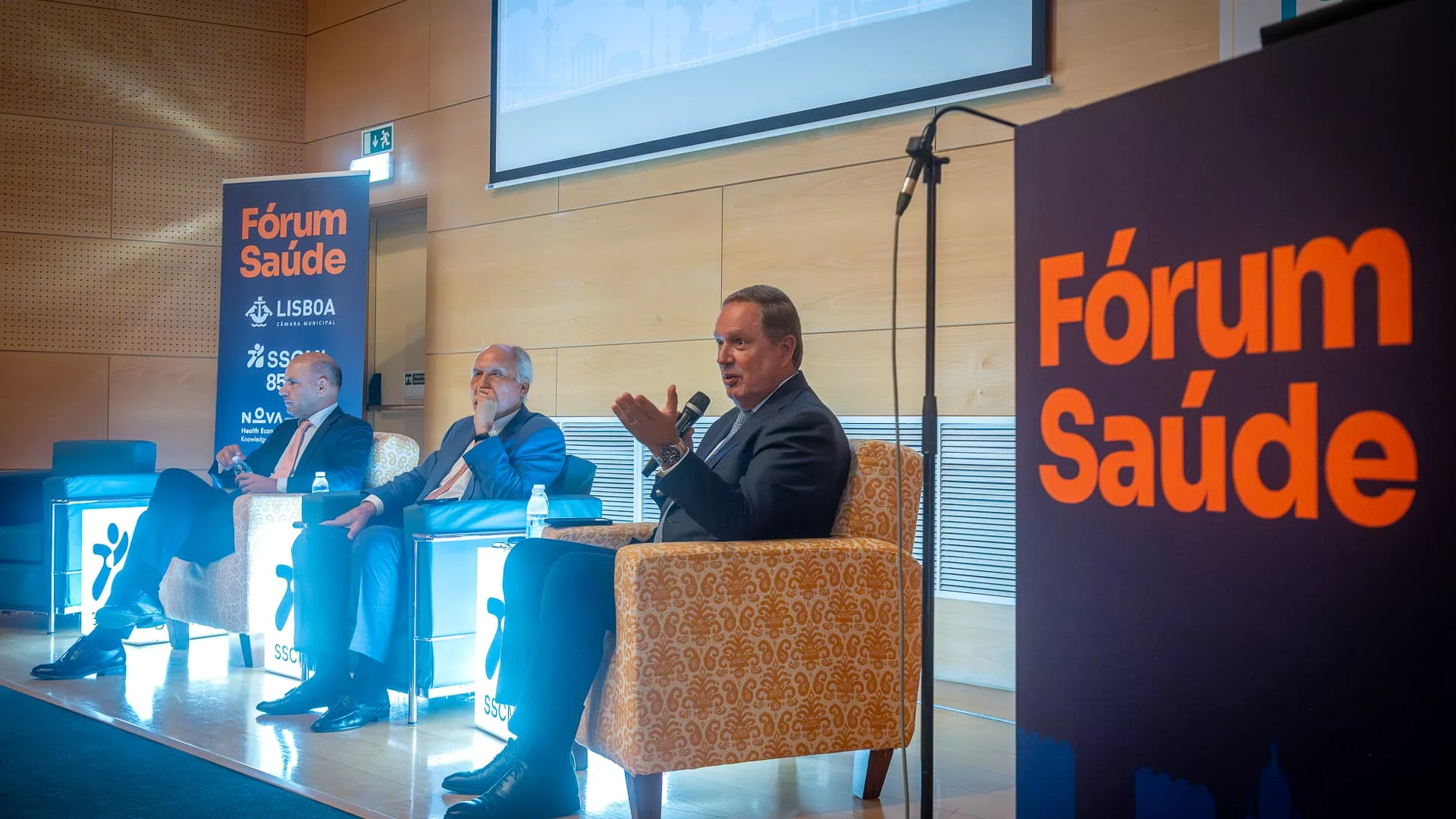
Under the theme “Local Welfare State: Challenges and Impact on Population Health”, the meeting brought together representatives from the health sector, local and central government, academia and the social sector to discuss the role of local communities in promoting health and tackling inequalities.
Santa Casa da Misericórdia de Lisboa was represented at the event by its Provedor, Paulo Sousa, who took part in the panel discussion “The implementation of local health strategies: Lisbon’, alongside Miguel Paiva, President of the São José Local Health Unit (ULS), and Clara Marques Mendes, Secretary of State for Social Action and Inclusion. Also present from Santa Casa was André Brandão de Almeida, the director responsible for health.
In his speech, Paulo Sousa presented Santa Casa’s perspective on the Local Welfare State and emphasised that health must be understood as extending beyond the response provided by hospitals and health centres. “Where is people’s health actually decided? Not just in the hospital or at the health centre. But also at home, on the street, in the neighbourhood, and within each person’s support network,” he stated.
The Provedor highlighted the importance of an integrated approach, based on proximity, coordination between services and shared governance between the State, local authorities, the National Health Service and the social sector. “By ‘Local Social State’ we mean proximity, integration and shared governance. No single body can solve this on its own,” he argued.
The experience of Santa Casa in Lisbon was presented as a concrete example of this integration. Through simultaneous intervention in the social and health sectors, the institution has a network of support services that accompanies people through different stages of life, from childhood to old age, covering areas such as disability, family and community, people experiencing homelessness, and healthcare.
Paulo Sousa also highlighted the importance of local presence as an essential element of the intervention. Santa Casa’s four local units cover all 24 parishes in Lisbon, enabling social care to be coordinated with home-based support services. “We don’t expect people to come to us. We are on the ground, close to home,” he emphasised.
Among the examples presented was the RADAR project, launched in 2019 and operating across all 24 parishes of Lisbon, which is based on a community network designed to identify, register, assess, refer and monitor people aged 65 or over. For the Provedor, “the secret of RADAR lies in the community network and a shared platform. No single organisation could achieve this level of reach on its own”.
The presentation also addressed the role of Santa Casa in the health sector, where the institution provides local services, specialist care, hospital care, long-term care and home care. In 2025, Santa Casa’s healthcare network had around 60,000 registered patients, more than 260,000 consultations and 18 healthcare centres, involving over 1,400 professionals.
Among the services highlighted was SOL, Oral Health in Lisbon, which since 2019 has been providing free oral healthcare to children and young people up to the age of 18 living in Lisbon. In March 2026, the project reached the milestone of 200,000 consultations and was presented as an example of an initiative that combines universality, prevention, complementarity with the National Health Service and networking.
Mental health and community intervention were also addressed, with reference to the W+ Unit, the work carried out in the community and the coordination between health and social care professionals.
For Paulo Sousa, Santa Casa’s experience allows us to draw five principles for building the Local Welfare State: “understand before responding, work in a network, integrate health and social care into the same pathway, ensure proximity and guarantee sustainability”.
At the conclusion of his speech, the Provedor put forward four proposals to strengthen the coordination of responses at a local level, such as the creation of joint planning cycles, the sharing of indicators and data, the recognition of the Misericórdias and private social solidarity institutions (IPSS) as planning partners, and results-oriented funding models.
“An elderly person who has been discharged but cannot return home needs the National Health Service (SNS), Social Security, the local authority and those who support them in their community,” stated Paulo Sousa, arguing that the solution lies in building bridges between the different organisations. “It is through these bridges between organisations that the solution reaches the individual.”
The Health 2026 Forum also featured presentations on the municipalisation of healthcare and community-based projects in Lisbon, as well as debates on different local health strategies and regional experiences from various parts of the country. The closing session included a speech by Ana Simões Silva, a councillor on the Câmara Municipal de Lisboa.
