20th Century
1911
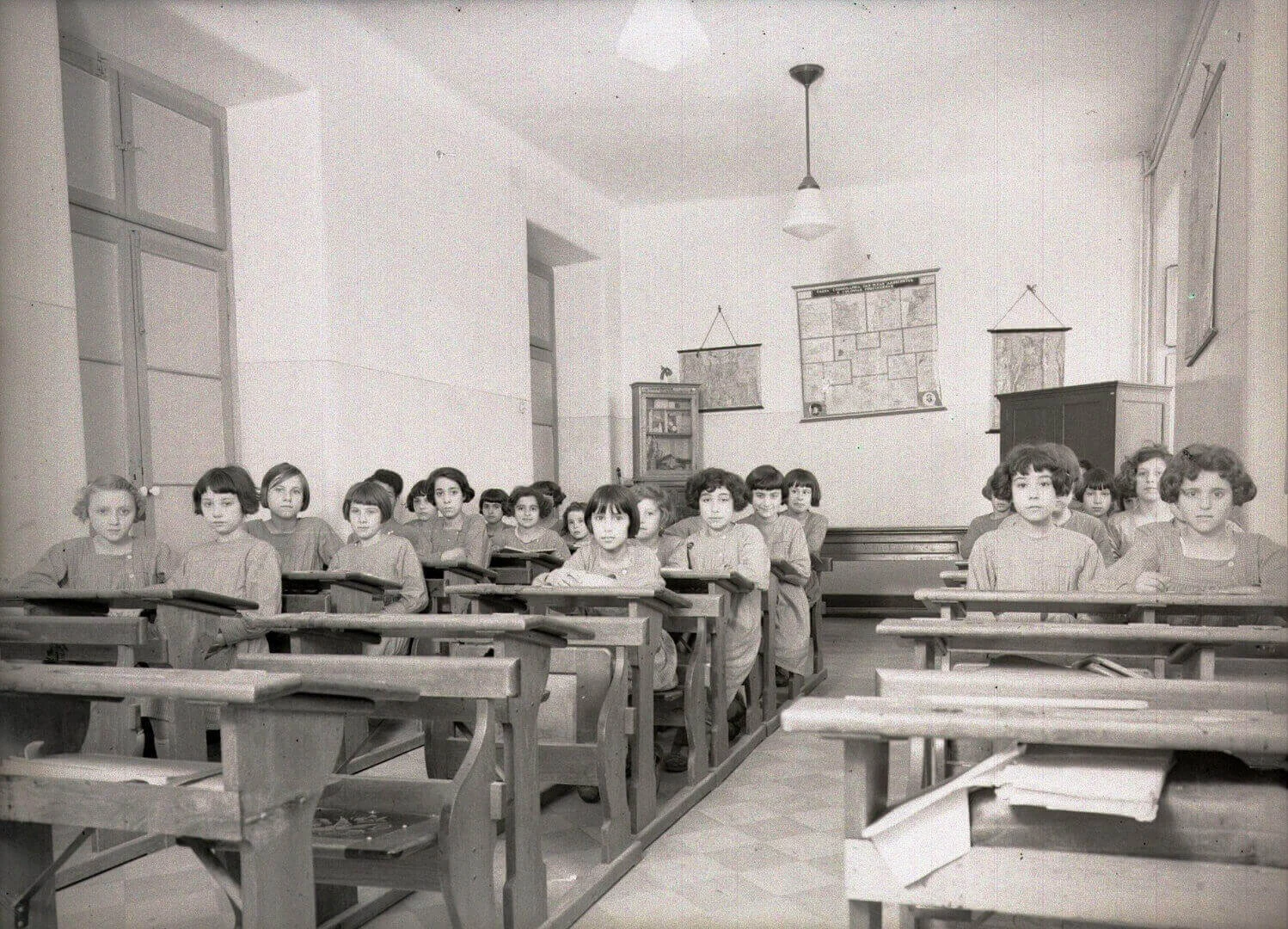
At the beginning of the 20th century, Misericórdia de Lisboa expanded its welfare work through:
- Care provided to children in its custody and orphans, focused on training, schooling, hygiene and child health;
- Refining clinical and home-visiting services;
- Expanding food assistance;
- Granting subsidies to various public and private institutions, some of which would later be incorporated into Misericórdia de Lisboa because of difficulties keeping going.
The Republic restructured the welfare system through the Law of 25 May 1911. This act created the Directorate-General for Welfare, which encompassed the Lisbon Central Welfare Office responsible for the charitable establishments, including the Civil Hospitals, Casa Pia and Santa Casa da Misericórdia de Lisboa.
1926-1931
Between 1926 and 1931, several institutions were incorporated into Misericórdia de Lisboa:
- In 1926, the bathhouses, night-time emergency posts, services for the distribution of subsidies and pensions (from the Lisbon Welfare Office) and the Instituto de Cegos Branco Rodrigues (Branco Rodrigues Institute for the Blind);
- In 1927, the infant milk depots (from Lisbon City Council) and the Sanatório de Sant’Ana, in Parede;
- In 1928, the Cozinhas Económicas, Sopas dos Pobres, Semi-Internatos (Colégio Araújo, the one at Travessa da Alameda and the one at Rua Artilharia 1), Pensionato da Rua da Rosa (housed in the Palácio Marquês de Minas), Instituto Infantil da Parede and the Maternal Schools of Alto de Pina and Ajuda;
- In 1931, the Vítor Manuel and Nossa Senhora da Conceição nurseries (from the Lisbon Association of Asylum Nurseries).
The Estado Novo introduced significant reforms. A central point concerned the creation of new social centres: the project for welfare in the area of Lisbon regarded Misericórdia as an operational and funding source, bringing together within the institution various welfare and social support bodies, such as the new Multi-purpose Social Centres and the Executive Commission for the Defence of the Family.
1935-1943
In 1935, Santa Casa inaugurated, at its headquarters, the Central Medical Institute and, in 1943, the Children’s Hospital of S. Roque, providing in-patient care in various specialties.
1957-1966
Between 1957 and 1963, a new management ethos and greater dynamism in problem-solving were introduced at Misericórdia de Lisboa. This new direction translated into the development of cooperation agreements with many welfare support institutions and the emergence of new services, such as Occupational Medicine — a genuine pilot centre where doctors and nurses received training.
Misericórdia de Lisboa’s interest in public health matters found expression in integrated medical-social care, a characteristic approach of the 1960s with a particular focus on preventive medicine. It was in this context that, in 1965, the Centro de Saúde e Assistência Dr. José Domingos Barreiro opened, built on land donated to Misericórdia de Lisboa and intended as a model of practice.
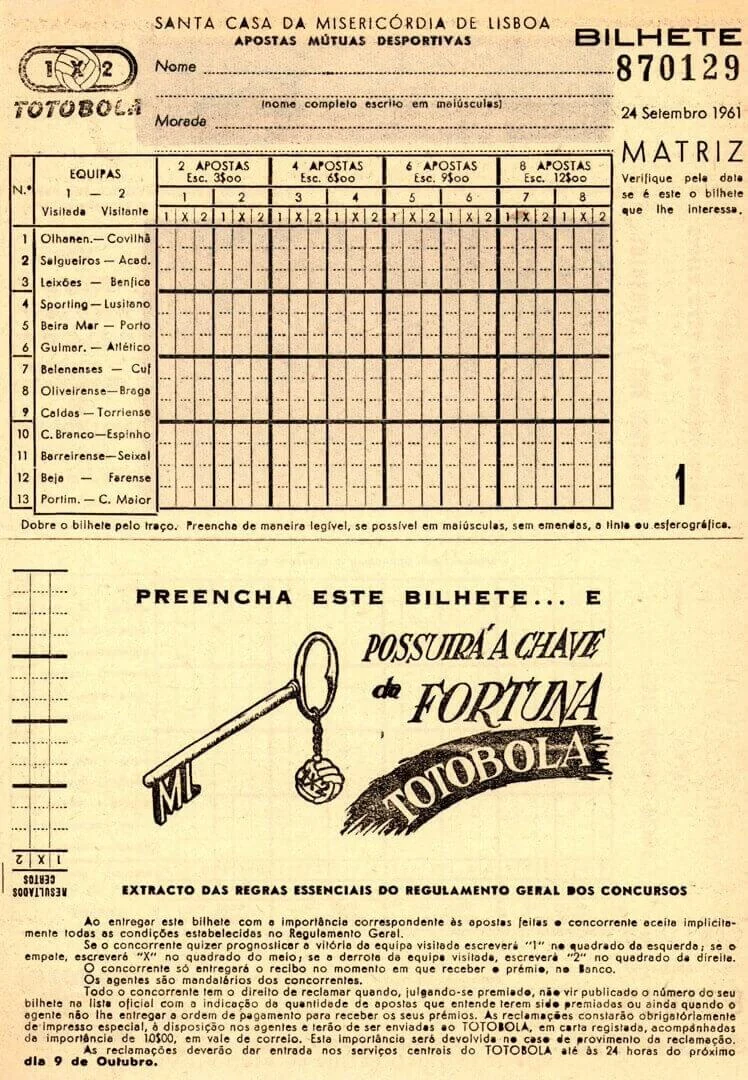
Totobola, created in 1961, helped increase the revenue from the social games. The net proceeds were split equally between rehabilitation care and the promotion of physical education and sport. This enabled Misericórdia to create the Centro de Medicina de Reabilitação de Alcoitão (1966), intended for the treatment of accident victims and people with motor impairments.
1974-1991
After the Revolution of 25 April 1974, the drop in revenue from the games — compounded by decolonisation and the consequent closure of overseas branches — led to severe financial difficulties.
With the creation of the National Health Service, all central, district and municipal hospitals came under the direct control of the Secretariat of State for Health. Initially unaffected by these decisions, Sant’Ana Hospital and the Alcoitão Rehabilitation Centre subsequently came under the Directorate-General of Hospitals, by virtue of Decree-Law No. 480/77 of 15 November.
In the revolutionary period, many social action institutions struggled to survive. Once again, the State opted to incorporate them into Misericórdia de Lisboa: the Municipal Neighbourhoods (1975, 1976 and 1977); Casa de Abrigo de Campolide (1976); Creche e Jardim de Infância de Santo António (1978); the Santa Catarina, São Pedro de Alcântara, Necessidades and Alcântara playgrounds (1979); Colónia de Férias Infantil de São Julião da Ericeira, Obra Social do Pousal, Internato de Menores do “Alvor”, PRODAC (Associação de Produtividade na Autoconstrução), CASU (Centro de Ação Social Universitário), Orfanato-Escola Santa Isabel (later renamed Aldeia de Santa Isabel), Centro Social da Quinta do Ourives, Centro Social do Bairro das Casas Pré-Fabricadas and Jardim Infantil de Palma e Fonseca (1983).
In 1978, Santa Casa strengthened maternal and child healthcare by introducing a Family Planning service.
In 1979, Santa Casa created its first library at the institution’s central services, at Largo Trindade Coelho, which remains open to the general public.
In 1982, Sant’Ana Hospital returned to direct dependency from Misericórdia de Lisboa, as did the Alcoitão Rehabilitation Medicine Centre in 1991.
Created in 1987, the Nunes Corrêa Verdades de Faria Awards fulfil the wishes expressed by Mantero Belard in his will.
1994-1998
The Escola Superior de Saúde do Alcoitão (ESSA), formerly Escola de Reabilitação de Alcoitão, was to be recognised as a Private Higher Education establishment.
At the end of the century, in 1998, Misericórdia de Lisboa defined a strategy for volunteering, creating a dedicated structure to drive this area of the institution’s work.
The 20th century is also marked by the launch of new social games, with the aim of generating greater revenue for other initiatives. Of particular note are Totoloto (1985), Lotaria Popular (1987), Joker (1993; suspended in 2017) and Lotaria Instantânea (1995; later renamed Raspadinha).
