Home / Social Welfare / Childhood, youth and family / Foster care
Foster care
Family Foster Care offers children a caring, secure, and temporary family environment that promotes their safety and well-being, while supporting their growth and development.

Videos
Seminário Acolher e(é) cuidar
LX Acolhe
“Pai é quem cuida… e acolhe”
WHY IS FOSTER FAMILY SUPPORT IMPORTANT?
How many children are seeking foster care in Lisbon?
1327
Approximately 1,327 children are in foster care in Lisbon (as of 2023).
How many children are seeking foster care in Portugal?
6183
Approximately 6,183 children are in foster care in Portugal (as of 2023).
Quantas crianças e jovens já foram acolhidos por famílias?
+ 180
Desde 2019, o Programa de Acolhimento Familiar LxAcolhe promoveu o acolhimento de mais de 180 crianças e jovens, evitando a sua institucionalização.
Quem pode ser família de acolhimento?
Qualquer pessoa
Individualmente considerada ou família, desde que um dos seus elementos tenha idade superior a 25 anos.
How old are the children?
Family foster care should always be chosen over residential care, regardless of age.
Mitos sobre
Acolhimento Familiar
Campaigns
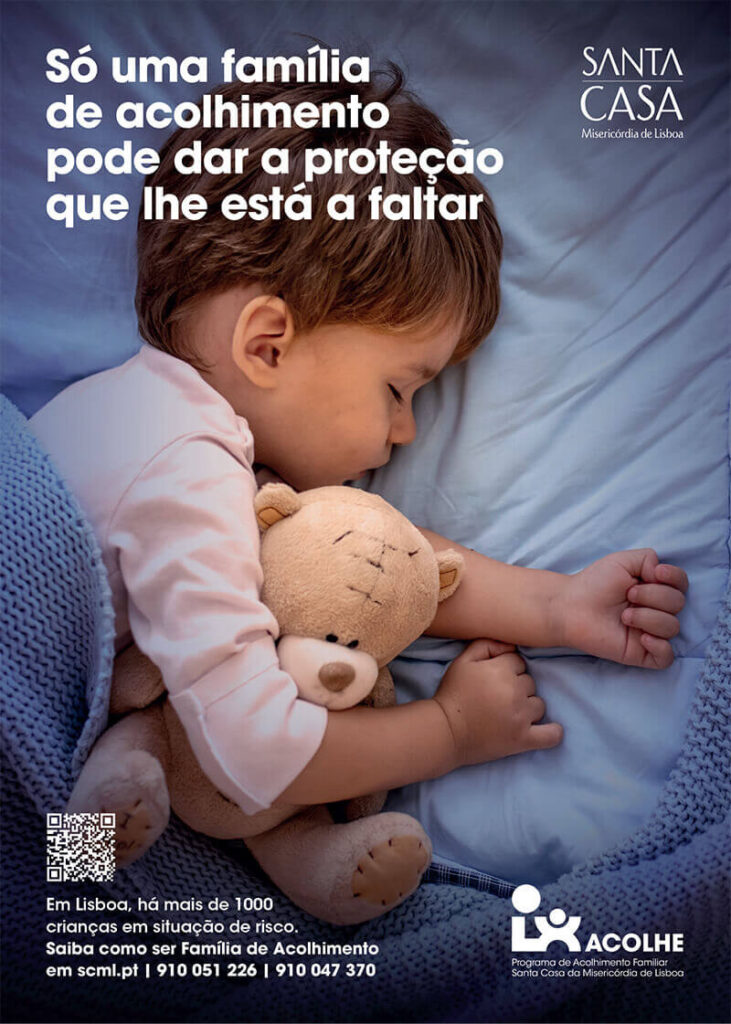
Programa de Acolhimento Familiar – LxAcolhe

#todosjuntospeloacolhimentofamiliar
There is an urgent need to ensure every child who needs foster care can live with a family.
A FOSTER FAMILY IS EXPECTED
- Availability to provide the child with all daily care, as well as individualized monitoring and attention;
- Ability to establish stable and secure emotional bonds with the child;
- Patience, perseverance, and flexibility;
- Empathy and the ability to help the child understand their own feelings and those of others;
- Respect for the child’s and their family’s life story;
- Openness to establishing a collaborative relationship with the child’s family;
- Integration of the child into their social network of family and/or friends;
- Collaboration with the team of professionals involved in foster care;
- Willingness to participate in initial and ongoing training.
TO THIS PURPOSE, A FOSTER FAMILY RECEIVES
- Ongoing training;
- Consistent technical support;
- Financial aid for the child’s care;
- And emotional rewards for helping others.
Foster families open their hearts and homes, offering children loving care, emotional support, and the encouraging stability they need to feel safe, belong, and grow.
Admission Criteria
Individuals over 25 years of age;
Individuals over 25, married couples, those in stable unions over two years, or relatives/family members sharing a home and meeting legal and health standards;
Individuals who are not inhibited from exercising their responsibilities;
Persons certified by a doctor as mentally and physically healthy;
Persons without a proven criminal record;
Applicants must have suitable living and safety conditions.
APPLICATIONS
Prospective foster families residing in Amadora, Cascais, Lisbon, Loures, Mafra, Odivelas, Oeiras, Sintra, or Vila Franca de Xira are required to attend an information session at the Foster Family Center, where they will receive comprehensive details about the process.
Foster Family Information Sessions
Session dates taking place in 2025:
January 24 | February 7 | February 21 | March 7 | March 21 | April 11 | April 24 | May 9 | May 23 | June 6 | June 27 | July 11 | July 25 | September 12 | September 26 | October 10 | October 24 | November 7 | November 21 | December 12 | December 19th
Book your information session in advance using:
+351 910 051 226*
+351 910 047 370*
servico.acolhimentofamiliar@scml.pt
* Call cost to national landlines
Frequently Asked Questions
Family foster care occurs when authorities temporarily place children in need with another family.
In cases where it is necessary to find an alternative to their family, Foster Care is the priority placement measure for a child, lasting until the child’s family develops the conditions to return to care for them or, if this proves unfeasible, another permanent family setting is identified.
During foster care, the child lives with the foster family and maintains contact with their biological family unless it is not in their best interest.
Being a foster family means caring for a child until they can be reunited with their family or transition to a permanent, adoptive home.
The following can be foster families:
- Individuals over 25 years of age;
- Individuals, couples in stable unions over two years, or family members who live together;
- Individuals who are not inhibited from exercising their responsibilities;
- Individuals must be certified by a doctor as physically and mentally healthy, have no proven criminal record, and possess suitable living, hygiene, and safety conditions.
Relatives and individuals applying for adoption can also be considered as foster families.
Whenever the prospective foster carer is a candidate for adoption, a special technical evaluation is required to ensure the best interests of the child or youth are protected.
Foster care is for children aged 0-18 in need of protection.
Children who have suffered or experienced situations that placed them in danger and without protection (neglect, emotional and physical abuse, abandonment, etc.). A foster care scenario presupposes a previous situation of suffering for the child or young person. This often influences their development and behavior. Therefore, it is crucial to emphasize that the safety and affection of a host family have the potential to mitigate the effects of these adverse life experiences.
The process occurs in several mandatory steps:
- Participation in an information session to submit an informed application;
- Formalization of the application;
- Participation in initial training for foster families;
- Application review: Initial Interview, Psychological Assessment, and Home Study; and
- Decision-making (selection/non-selection).
Some families provide weekend care and are referred to as “volunteer” or “friendly families.” They maintain only occasional relationships with institutionalized children.
A host family provides daily, loving care and support, creating a sense of family and consistency. Through the LX Acolhe Program, just as in other countries, foster families can also support one another by caring for children during vacations or offering respite when needed, ensuring every child always feels cared for.
Support families must complete the same training, assessment, and selection process as foster families.
If approved under the law and in the child’s best interests, children may stay with and be adopted by their foster family.
Yes. A child who is in a foster family can be adopted, once the possibility of reintegrating with their family of origin has been exhausted, by another family already selected as an adoptive family or by the foster family, strictly respecting the best interests of the child or young person.
Foster care is temporary and continues only as long as necessary to fulfill the foster child’s life plan—whether reunification, adoption, civil sponsorship, or independent living—to ensure a permanent family solution. During foster care, all involved—the child, foster family, family of origin, adoptive family, and civil sponsors—receive technical and ongoing support, aiming for a smooth transition.
A foster family receives initial and ongoing training, support from a technical team, workplace absences and leave similar to those of parents, and financial aid for the child’s care.
A foster family receives monthly financial aid per child—1.2 times the social support index (IAS), with a 15% increase for children under 6 or those with special needs, as defined by law.
During assessment, foster families are encouraged to thoughtfully consider and share the child’s profile that they feel best prepared to welcome and care for.
The aim is to clearly understand which children the family is willing and able to foster, taking into account their needs and background.
Yes. The information available for decision-making about placement is always shared with the foster family. The final decision to proceed with the placement is made by the foster family.
Yes. Children in foster care have the right to maintain contact with their families. Contact can take different forms (in-person or remotely) and is based on a plan tailored to each specific situation.
In-person contact occurs in neutral locations, facilitated by technical teams.
For the foster family’s safety and privacy, their address will not be disclosed.
Yes. Once the technical teams involved consider that all conditions are met, a meeting between the two families may be held.
This meeting typically occurs in most foster care situations and is held in a safe and neutral location. The goal is to allow the child’s family to get to know the person caring for them.
Yes, as long as the child’s parents (or the court, in their place) authorize the move abroad.
No. Foster families cannot resort to physical punishment, such as spanking, pushing, hitting with objects, or placing children in uncomfortable positions, among others.
The fundamental principles of foster care are to provide an environment of protection, care, and affection—the opposite of violence.
All children, due to their unique characteristics, which are related to their potential, vulnerabilities, and dependency, need more protection, not less, against any type of violence, including any disciplinary practice that involves physical or psychological abuse.
Resorting to physical punishment is a crime and leads to the termination of foster care.
Yes. The eighth amendment to the Law on the Protection of Children and Youth in Danger, approved by Law No. 147/99 of September 1, guarantees the child’s right to “maintain contact with the foster family after the end of the foster care measure, whenever it is in the best interests of the child.”
There are foster families composed of only one adult, large families, couples with and without children, blended families, single-parent families, same-sex families, families with extensive parenting experience, and others who have never had children but have a lot of love to give.
There are families from diverse cultural backgrounds and with vastly different histories who share a desire to make a positive impact in the lives of the children they foster.
DOCUMENTOS
Tríptico Acolhimento Familiar
270 KB | PDF

Lei n.º 37/2025, de 31 de março (Possibilita que familiares e pessoas candidatas à adoção possam ser famílias de acolhimento e reforça os direitos das crianças e jovens em acolhimento), alterando a Lei n.º 147/99, de 1 de setembro, e o Decreto-Lei n.º 139/2019, de 16 de setembro.
594 KB | PDF
Lei n.º 142/2015 de 8 de setembro (2.ª alteração à lei de Proteção de Crianças e Jovens em Perigo, aprovada pela Lei n.º 147/99, de 1 de setembro)
281 KB | PDF
Decreto-Lei n.º 139/2019 de 16 de setembro (Estabelece o regime de execução do acolhimento familiar, medida de promoção dos direitos e de proteção das crianças e jovens em perigo)
685 KB | PDF
Contacts
Family Shelter Center – LxAcolhe Program
Rua da Rosa n.º 203-207
1200-384 Lisbon
+351 910 051 226*
+351 910 047 370*
servico.acolhimentofamiliar@scml.pt
* Call cost to national landlines